
Porsche : 911
1964–present
Model Introduction
The original Porsche 911, introduced in 1964, replaced the 356 and became the brand’s enduring icon, with styling by Ferdinand “Butzi” Porsche that evolved only subtly over its first 25 years. Powered by air-cooled flat-six engines ranging from 2.0 to 3.2 litres, it was offered in various forms including the T, E, and S, as well as high-performance variants like the Carrera RS 2.7, famed for its ducktail spoiler and motorsport pedigree. The 911 also spawned the Turbo (930) in 1975, bringing wide arches, dramatic rear spoilers, and blistering straight-line speed. Known for its distinctive driving feel, rear-engine balance, and competition success, these pre-964 models laid the foundation for one of the most recognisable and celebrated sports cars in the world.
Magazine articles (13)
Magazine Articles
-

Porsche 911
Six cylinders, five forward speeds, four disc brakes, three seats (well, almost) and two overhead camshafts add up to one hell of a car
-

A capital S from Porsche
-

Porsche 911e
We revisit Stuttgart to investigate the latest changes to the Porsche range
-

Running with the Wolf
Porsche Carrera RS Touring
-

The road goes on
A last-minute reprieve saved Porsche's 911 from death this winter. Overleaf, Georg Kacher explains why Porsche would like to kill it but can't and Ian Fraser takes the latest SC - bouncing back better than ever - out for a hard day's drive
-

Porsche give the 911 a Carrera birthday
Porsche are marking 20 years of 911 production with the release of a new 911 Carrera for 1984.
-

Open and shut cases
Porsche 911 Cabriolet
-

Black Magic
The purposeful looking all-black Carrera in the snowy white landscape is German stylist Vittorio Strosek's first exercise on the classic Porsche 911 shape, a subtle restyling which brings out the best of the 911's own strong character without losing its stylish simplicity.
-
Franco-Prussian War
In the right-hand corner, the Porsche 911 Carrera Club Sport, latest in a long line of winners - launched only this year and already a superstar - weighing in at £35,849. And in the left, the much-fancied Renault GTA V6 Turbo, undercutting its rival by near £9000
-
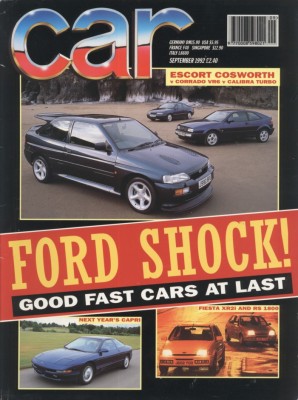
Around The World
The 1993 model year Porsche 911 Turbo RS, out this autumn, gets an even stronger engine: a 380bhp two-valve, capable of churning out a massive 360lb ft of torque.
-
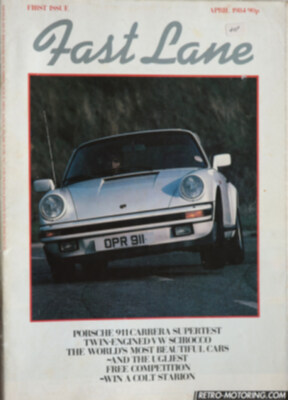
Porsche 911 Carrera Sport Supertest
OF ALL the ‘supercars’, the Porsche 911 stands apart. Even when it was introduced 20 years ago, it was ‘wrong’; it is almost as if Porsche wanted to prove that a high-performance car with an inherently difficult design, an air-cooled engine overhanging the rear wheels, could be made to work properly. An overhanging rear engine offers one major advantage - excellent traction - but a lot of disadvantages. Only one other sporty car, apart from the low-volume Alpine-Renaults, has gone into production with this configuration since the appearance of the 911 - the DeLorean. As an interesting aside, Porsche did some work on the DeLorean’s suspension shortly before the Dunmurry balloon burst. Similarly, an air-cooled engine is not ideal; though it allows the designer not only to dispense with a water radiator but also to improve the aerodynamics of the car’s front end, and also simplifies cylinder block castings, it is inherently noisier and is guaranteed to give heater engineers a severe headache. Yet here is the 911 in its latest incarnation, if anything more attractive to the high-performance driver than ever. Porsche are renowned for their development engineering, and the worst effects of having all that mass at the rear have been carefully tuned out over the years, while the heating system does work, if not as well as in a comparable car with a water-cooled engine. The latest Carerra is the first Porsche to bear that name since the 924 Carrera (a homologation special), and the first 911 since the 3.0-litre 1977 model.
-
JP's View
TO BE honest, in many everyday driving situations I cannot help questioning whether such expensive machines as the 911 Carrera really confer any advantage over those infernal family hot rods, GTis, XR3s and the like, that will cling triumphantly to one’s tail on a country lane like a terrier dog. Switch to a fast sweeping ‘A’ road though, and the theoretical status quo returns. Here the 911 is in its element. Real performance is appreciated at high speed only. Many cars will feel fairly potent up to 100mph or so, but the 911 sweeps through this mark with about as much fuss as most machines at 60mph. Once an experienced driver is familiar with the car, it is all so undramatic, the low drag of that elderly body shape coupled to 231 bhp and just over a ton providing a surge of acceleration to over 140mph before ‘‘gathering momentum” takes over. Despite the terrific straight-line performance of the 911, impending corners are little more of a hindrance than to any other car, such are its braking and roadholding qualities. On looking at the speedo exiting a series of fast sweeping curves, you discover that you’ve been doing perhaps 20mph more than you thought. When you drive the Carrera briskly, everything is so well harmonised that it is one of the world’s most exhilarating driving experiences. The wail of the smooth flat six, its taut responsive chassis, and its journey shrinking ability are all fabulous.
-
From 130 to 300bhp - 20 years of 911 development
CAN YOU imagine a four-seater 911? Or a 911 with a pushrod engine? As we know the famous Porsche today, a pure Grand Touring machine with a string of racing successes to its credit, it is quite hard to believe that the first design to come off the drawing boards in Stuttgart was a family sized model, which some people thought was needed to replace the 356. Fortunately these designs did not please Dr Ferry Porsche who set his eldest son, Ferdinand ‘Butzi’, to work on a fresh design which saw the light of day at the Frankfurt Show in September 1963. Dr Porsche’s concept was a 2+2 which would be faster than the 356 Carrera, larger inside, but still a sports car, while being more comfortable and easier to maintain. Neither Erwin Kommenda, who designed the four-seat body, nor Klaus von Riicker, who inspired the pushrod engine, had much future with the Porsche organisation and while the Reutter coachbuilding concern produced a new body to Butzi’s design, Hans Tomala was set to work on finalising the design of a flat-six alloy engine with a chain-driven camshaft on each bank. Dry sump lubrication was specified to keep the engine as compact as possible, and in its original 1,991 cc form the unit developed 130 bhp at 6,200 rpm, and 119 Ib ft of torque at 4,600 rpm.


